Friday, July 06, 2007

10 Principles of Improv and why you should care

I've been meaning to get to two posts for months now: A post about Toastmasters (the toast post) and a post about taking improv classes in Philly. Well, this is a (slightly modified) version of a Toastmasters speech I recently gave about my experience with improv. Two birds, and all that :-)

A few months ago I started taking Improv classes in Philadelphia on Monday nights. I signed up for improv not because I have a burning desire to be the next Will Ferrell or Mike Myers, nor any illusions that you’ll soon be seeing me on the big screen or on SNL. What inspired me to sign up for class was a small, remarkable book called Truth in Comedy, written by Charna Halpern, Kim Johnson, and Del Close (one of the most important influences in modern day comedy improv. Just look at the list of folks he mentored!)

The more I read about improv, the more I realized that the principles of good improv are also the principles of living a good, centered, happy, connected, and fulfilled life. So today I’d like to take a few minutes to share 10 improv principles with you, and tell you a little bit about my experience of the past eighteen weeks learning to doing improv.

First I think it’s useful to briefly address the question, "What is Improv?" Inevitably when I tell someone I’m learning to do improv, they say something like, "Oh standup comedy, I could see you doing that." So let’s clear this up right away: Improv is not stand up comedy. In many ways it is the antithesis of stand up. Stand up is generally written, memorized, practiced and polished. It's also (usually) a solitary activity. Improv is spontaneous, free-flowing and created on the spot. It's also (usually) a team sport.

Often it's the unscripted nature of improv that is most associated with the form, and for that reason many people say things like, "You’re doing improv—isn’t that hard? Isn’t that scary to work without a script? To have to make it up on the spot?" To which I can only reply with a scratch of my chin, "Hmmm… Having to make it all up on the spot… That sounds familiar. Where have I heard that before??? Oh yeah!!… it’s what we do every single day of our lives!"
Look, not only can anyone do improv, we are in fact, all of us, doing improv all the time.

Let me ask you: When you were born, were you handed a script that layed out all of your lines so you'd know just the right thing to say and do for the rest of your life? I don't think you got that script. I don't know anyone who got that script. I know I didn’t get that script. So we’re doing improv all the time. All the time. Every day. You. Me. Them. We're improv-ing baby!

And you may have noticed that IN our unscripted lives, sometimes, 'stuff' happens. And learning and practicing the principles of improv can help us deal with that stuff.

TEN PRINCIPLES OF IMPROV


Principle 1: Be prepared (Warm up!)
In my improv class we don’t rehearse scenes, but we do practice. We do train to learn and internalize certain structures and methods the way jazz improvisers learn scales. Before getting into scene work, we activate our minds and bodies by playing games; games that will help ground us physically and emotionally to characters we create in scenes. Sometimes we play 2 or 3 games at once to help sharpen our awareness and listening skills and get us out of our heads. Props to the Boy Scouts on this one.

Principle 2: Willingness
Willingness to do what you ask? A lot. We have to be willing to fail, and fail spectacularly. Since we don’t know what’s coming next, we have to accept that we may get knocked off balance. Therefore we have to be willing to mess up –and mess up big time.

Being willing to fail spectacularly means being willing to take risks. Lack of success is not due to trying and failing; it’s due to not trying, often out of a fear of failure. Being willing to fail means being willing to look foolish. It’s been said that we wouldn’t care so much about what people thought about us if we realized how seldom they do. If we’re not willing to look foolish doing improv then we won’t risk, we won’t commit, and the scenes will lack energy and direction. Being willing to risk reconnects us with the zest and energy of life. When we risk, our senses our heightened, our adrenaline is flowing. It’s a rush.

Finally, we have to be willing to make mistakes. The point is not that there are no consequences. Rather, it’s accepting that if we are truly risking there is no question that we WILL make mistakes. But we also realize that others are there to help dig us out of our mistakes. And ultimately it’s our mistakes that lead us to growth and improvement. We learn to choose better next time.


Principle 3: Stay in the Moment
In improv what is happening NOW is the key to discovery. I was at a Library Futures conference recently and heard someone say, "I’m very interested in the future because that’s where most of my life will happen." That got a big laugh. Well I’m very interested in this moment, because that’s where ALL of my life has happened. And I’m pretty sure that’s where most of the action is. (Coincidentally, it was at the library futures conference that Mary Catherine Bateson suggested that the best way to prepare for the future is to take an improv class...)


Principle 4: Shut up and Listen
Good improvisers are not necessarily more clever, or more quick-witted. They just listen better… Improv is about hearing what others are offering, and building off it. It’s hard to do that when your gums are flappin’.

Principle 5. Action beats inaction
Don’t talk about doing it, do it. Be specific. In Improv there is a "bias for action". I’ve also seen the term "bias for action" listed as a common trait of effective leaders. Why? Because active choices move things forward. The more specific the choice the better. Specific choices are committed choices. Specific choices move things forward and allow others to respond to and build off of your offers.

Principle 6. Be honest
In improv we are taught to express whatever is coming up in us at that moment. To do that we have to learn not to censor or judge our own thoughts, which requires some major rewiring of the brain… The only value we bring to the scene is our honest response to what’s happening.


Principle 7: Let go of (your need to) control
The only thing we can control are our own choices. Realizing that we are not in control of anything else is the key to de-stressing and getting into the flow. And the flow is where we are creative. The flow is where we are productive. The flow is where we are connected to others. The flow is where we are happy. [an aside] Interestingly… What happens when we stop focusing energy on things that we can’t control? That energy gets focused on things that we can control, and ironically, we end up exerting more influence.


Principle 8. There are no mistakes
Earlier I said that we have to be willing to make mistakes. But moving beyond that, we learn to not see choices as mistakes. In improv, there are no mistakes or bad ideas, there are only interesting choices. We respect all the choices (aka offers) made by others, and find ways to build off of them, no matter how challenging they may be. There are no mistakes because everything can be built upon. Everything that happens is an opportunity.

Principle 9: Trust
Learning improv we learn to trust ourselves. We trust our impulses and our choices (which we can do because there are no mistakes, and we are not alone.) And we learn to trust in others (to "justify" our "interesting choices", build off them, and weave them into the fabric of the scene.) When learning to trust our ideas, it helps to remember that ideas are infinite. So no matter what strange hole it seems we’ve dug ourselves into in a scene, there are an infinite number of ideas that can help dig us out.

Principle 10. Teamwork (row, row, row)
We’re all in this together. No one person is responsible for the success or failure of a scene. It succeeds, or not, based on our ability to work together. This requires strong individuals making strong choices, who trust each other and themselves. As a group, we learn to focus on solutions. As individuals we learn to focus on getting results (i.e. moving the scene forward) instead of being right, or angling for attention or credit. We rise, or fall, as one.

The Uber Principle: "Yes, and..."
So there are the big 10 principles of improv as seen by an improv newbie. But I’d like to conclude by mentioning one final improv principle. It’s a principle that runs through all the others and infuses improv with it’s spirit. This is the principle of "Yes, and". "Yes, and" means that we accept everything that happens as an offer, as a gift. It is our job to bring our unique perspective to bear, and build off of whatever is given to us. "Yes and" implies acceptance, but not acquiescence. "Yes and" acknowledges the reality of the moment, but also inspires us to create the future.

In the end, "Yes and" is a powerful attitude of affirmation. It is an attitude that affirms ourselves, and therefore gives courage. It is an attitude that affirms others, and therefore inspires trust. And it is an attitude that affirms what is and therefore inspires hope and excitement for the possibilities of what may be as we join together to create our shared future.

Friday, June 29, 2007

Tootling one's own horn

(this has been sitting in drafts for 3 weeks.)

File under, "Tootling one's own horn" In this case mine. Hey look everyone, I've learned to talk good!

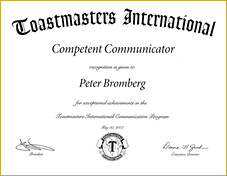
Yes, I am now an official Toastmasters Competent Communicator (aka CTM).

Toot! Toot!

Yes, posts about ALA coming soon (for now here are the pix.) And more on public speaking, doing improv, library futures.


Thursday, May 31, 2007

8 things (Pete)

Wow, the whole blog's been tagged. Here goes my part:
  1. I really, really, really want to visit Australia.
  2. Every year I walk around the lake outside my office and take pictures of the newly hatched baby ducks and geese. It's hard not to smile when looking at the fuzzy goodness of baby ducks.
  3. At any given moment I'd almost certainly rather be playing tennis. It's very Zen.
  4. Joe Versus the Vocano is one of my favorite movies and I don't understand why it's not more widely loved.
  5. I just finished reading Eat, Pray, Love. A wonderful book!
  6. I kept a dream journal for years, sometimes recording 10-15 dreams in a night. There are more things in heaven and earth, Horatio...
  7. I really, really, really tend to like people. (which is good, considering how many of them there are running around out there.)
  8. Animals? Not so much. I wish I liked animals, I just usually... don't. Which is unfortunate considering how many of them there are running around out there. (Baby ducks, and other furry youngin's excluded, of course.)

Friday, May 25, 2007

Friday Fun: Are you old?

The bloggers at Library Garden have a little listerv on the side that we use to stay in touch with each other, and this week we found ourselves questioning whether or not we're old. This was prompted by an experience Amy had at the reference desk, and I'll let her blog about that if she chooses.

I was reminded of an old SNL monologue by Billy Crystal where he recounts his young daughter saying to him, "Daddy, is it true that Paul McCartney was in a band before Wings?" To which he replies in the voice of an old Jewish man, "Let me tell you about a little band known as... THE BEATLES."

In an effort to help Amy feel a bit younger, I posed these questions on the listserv and suggested that if she could answer 'no' to ten of them, she's decidely not old. At her suggestion, I'm sharing them here. Enjoy! And a most pleasant weekend to all!

  • Did you ever have a black and white TV? One with knobs (no buttons, no remote)
  • Did you ever NOT have a microwave oven?
  • Did you ever have a car with a "choke"?
  • When you were growing up were you limited to 12 channels?
  • Do you remember when people used to smoke on planes?
  • - And in stores?
  • - And at work?
  • - And in bed?
  • Do remember when the FDA tried to ban saccharine?
  • Do you remember when laetrile was going to cure cancer?
  • Have you ever known a world without:
  • - velcro?
  • - computers?
  • - digital cameras?
  • - compact discs?
  • Do you remember when polaroid was state of the art?
  • Do you remember when tape recorder meant reel-to-reel?
  • Did you ever take a tube out of your tv and bring it down to the local hardware store to test it on a big machine to see if it needed replacing?
  • Did a teacher ever make you run things off on a mimeograph?
  • Do you even know what a mimeograph is?
  • Did you ever wear parachute pants?
  • Do you remember when PONG was the most cutting edge video game and you thought your head would explode from the joy of playing it?
  • Did you ever have a commodore vic 20? (and thought your head would explode, etc...)
  • Do you remember when we didn't own our own phones; we rented them from Bell Atlantic?
  • Do remember when the flip phone first came out and you thought your head would explode from the joy of flipping it open?
  • Do you remember stores giving away green stamps?
  • Do you remember shopping at Two Guys? at Korvettes?
  • Do you remember when Exxon was Esso?
  • Do you remember when gas was .55 cents/gallon and people were freaked out about how expensive it was getting?
  • Do you remember waiting on long lines to gas, and you had to go on an "odd" day or an "even" day.
  • Do you remember when Iran and Iraq were our friends?
  • Do you remember listening to Bobby Sherman on 8-track?
  • Do you remember twoallbeefpattiesspecialsaucelettucecheesepicklesonions- onasesameseedbun (and can you sing it?)
  • Do you remember when the coffee stirrers at McDonalds had little spoons on the end?
  • Do you remember when McDonalds discontinued them?
  • Do you remember WHY McDonalds discontinued them? (snort, snort)
  • Do you remember Hamilton Jordan at studio 54 (see a theme here?)
  • Do you remember ABSCAM?
  • Do you remember ME shirts (talking about McDonalds)?
  • Do you remember when Pet Rocks were the rage?
  • Do you remember Squirmels?
  • Do you remember When Evel Knievel jumped the Snake River Canyon? (well, he tried anyway)
  • Do you remember that George Hamilton movie where he played Evel Kneivel??
  • Do you remember Beer commercials with the "ya doesn't have to call me johnson" guy?
  • Do you remember Aste Spumante commercials?


Tuesday, May 15, 2007

NYT online hotlilnks---WTF??

Lately I have been noticing that the NYT online edition makes some very, um, interesting choices when deciding which words in an article need to be hyperlinked to additional information. I guess my question to whatever unpaid intern they've assigned to the job is: "What are you smoking, and haven't you read the latest research on what that does to you???"

When used sparingly and caringly, hyperlinks, the modern day equivalent of what my pappy called "footnotes", can be our friends. (for more information on footnotes, see footnotes)

Take for instance today's Science Times article, A Giant Takes on Physics Biggest Questions. My first thought was, "Oh boy, an article about giants! I KNEW they really existed, I just KNEW IT!!"

Guess what? The article's not even about giants (I know, I was pissed too. I bet the same stupid intern who does the linking also writes the misleading headlines.)

OK, after I get over my disappointment that the article is actually about a bunch of fizzisists 300 feet below the ground trying to re-create the beginning of the universe by smashing tiny little particles into each other, I sit back and say, "hey, cool, I've been meaning to brush up on my particle physics. But I'm a little rusty on some of the basic concepts and lingo of advanced theoretical phenomenology. It sure would be helpful if the NYT would footnote -- oops, I mean hyperlink -- some of the hardcore scientific stuff to definitions, background information, biography, or further material that might enhance my ability to understand any of this."

The NYT chose to go another route.

In their six page article on theoretical particle physics, this is what they thought was really important to hyperlink:

Page 1: On a page containing such terms as "European Center for Nuclear Research (CERN)", "Large Hadron Collider", "electron volts of energy", "dark matter" and "dimensions of spacetime", the only word they thought was important to hyperlink out to more information was...wait for it... Earth. Earth? EARTH???? I guess they chose to hyperlink it for those few souls who read the New York Times online that don't know that Earth, " is the third planet from the Sun and the only one in the solar system known to harbor life."

Page 2: Unlinked go search terms as, "trillion-electron volt Tevatron", "antimatter opposites", "antiprotons", "Fermi National Accelerator Laboratory". And the hotlink goes to... Nobel Prize. And not even to a definition of Nobel Prize, just a link to random articles in the New York Times that mention "Nobel Prize." Super! (a good a time as any to note that ALL hyperlinks, save perhaps paid ads, on the New York Times website only link back to---you got it--- the New York Times website. Super!)

Page 3: Unlinked terms: "Cocktail party physics" (I'm guessing, not so much with the fun), "God particle", "Higgs Boson", electroweak force", "Planck energy". And the hotlink goes to... Nada. No hotlinks. Skippy the unpaid intern must have been checking his MySpace page for messages.

Page 4: Unlinked terms: "Quantum weirdness", "supersymmetry", "photons", "glunino". And the hotlink goes to... I guess Skippy's busy twittering.

Page 5: Unlinked: "primordial fluid", "quark-gluon plasma", "Compact Muon Solenoid". And the link goes to, "radiation." Which I could actually let slide if it didn't lead back to a bunch of random NYT articles, mostly about cancer, that mention the word radiation somewhere.

Page 6: Unlinked: "Fermilab Tevatron", "CDF", "UA1 and UA2", "LHCb". And the link goes to... Uh, nothing.

But wait! I now notice at the bottom of every page a little link that says, "Sphere: Related Blogs & Articles". Yes! I knew the New York Times was just screwing with me! Now I'm going to click on "Sphere"* and get all sorts of related theoretical particle physics goodness. Here I go... I'm gonna do it... < CLICK! >

The good news: Sphere actually links to material outside of the NYT universe. The bad news: This is what it links to:

I'm speechless. I am without speech.


*Sphere: "Connecting Blogs and News"


Wednesday, May 09, 2007

Library Futures Conference Roundup, pt 1

I had the mind-blowing pleasure of attending Imagination to Transformation, the Mid-Atlantic Library Futures Conference, on Monday and Tuesday. I have lots of notes notes notes, a swirl of ideas, and a pile of inspiration. In the interest of sharing the goodies, I'm posting my notes in a fairly raw form with limited commentary. Get it right or get it written, right?

Before I get into my notes, a big thank you to the New Jersey State Library (esp. Peggy Cadigan) , Palinet (Catherine Wilt, Ann Yurcaba, Diana Bitting), and all of the organizers for all their hard work and for doing a fantastic job! Great speakers, great space, great conference!


For those of you following along at home, conference materials and handouts will be posted on either the conference website and/or the conference blog.

OK, here are my notes from:

LIBRARY SPACE: IS IT THE LAST FRONTIER OF THE DIGITAL AGE
Jeffrey Scherer of Meyer, Scherer & Rockcastle, Ltd.

(BTW, this is a highly filtered report. Scherer talked a lot about lighting, about environmentally friendly building design, and many other fascinating topics. I highly recommend you take a look at his whole presentation when it's posted to the conference website.)


  • The library in 2030 will be as different from today’s library as today's library is from the library of 1930.

  • The library as a central place is the only single political agent that can affect change at all levels. Our neutrality is an important tool for us to think about.

  • The library is an agent of these four elements of our lives: live, work, play, learn.

  • We are a service profession that delivers great content, struggles with technology and frets over cash. The real decisions are made around cash. If you reflect on the fact that Americans spend as much on Halloween candy as they do on library books, you see that the $$ is there.

  • We need to stop focusing on what is not possible, and focus on what is possible. It’s important to be optimistic. If you focus energy on what’s not possible, you’ll never create the possible.

Quotes:

  • "Our eyes connect our emotions."
  • "Love is probably the central focus of great libraries"

Guiding principle: We need to create space for spontaneity and socializing: the library as 3rd place (agora)

Carleton college did a survey of alumni: 40% of graduates married other Carleton students; 40% of those people met in the library. Why? Because they were in a different social space than if they had met at a football game. Being in a library raises our commonality; transcends our boundaries.

Applying the lessons: How to create a 3rd space:

  • Reading nooks with back to wall (people love to curl up)
  • Daylight and views
  • Computer tables (missed some of what he said on this)
  • Offer a variety of options
  • Self-controlled lighting
  • Daylight and good views
  • Gossip corners that don’t interfere with others
  • Homelike features; fireplace, natural flooring
  • Group seating that can work with one to three people
  • Privacy (acoustic and visual): people want to get information in private
  • Visibility of service points and collection
  • Come out from behind the desk and greet patrons. There has to be a transformation in this area!

Other key points

  • "I want to do it myself" Trend to self service is huge.
  • "Help is on the way" but only if you need it. (Point of need service delivery)


Saturday, May 05, 2007

Free Comic Book Day--Highlighting "Super Librarian" Comic in NJ!


The third phase of the Super Librarian campaign begins today, May 5, 2007, in conjunction with North America's 6th Free Comic Book Day, a single day when participating comic book stores (find one near you) give away comic books for free to anyone who comes into their stores. It usually coincides with the release of a well-known superhero movie--and this year, it is Spider-Man 3 (can't wait to see it myself later today--and yes, I got my tickets earlier this week!).

Well, as much as I am interested in seeing Spider-Man 3, I am just as interested to visit my local library as the brand-new Super Librarian comic book will be proudly given out at over 200 New Jersey libraries. Why is this important? Nancy Dowd from the NJ State Library explains the history behind it at her blog--here's an excerpt:

"...the target audience from the general population to the tweens and teens. We had run a contest having teens write a backstory and from there two very talented librarians (David Lisa and Manny Rosca- Miracle) stepped forward to write the comic itself.The comic was drawn by a professional graphic designer. Appealing to the YA librarians just made sense. The next big step was finding a way to launch. Partnering with Diamond Comics for their Free Comic Book Day gave us a national event to join AND gave our libraries an added incentive to join up. Sure enough the new strategies worked... we have over 200 libraries signed up. Those libraries close to a comic book store are partnering with them and will hopefully create some great synergies. Those that don't have a comic book store nearby will be getting free comics from Diamond. Everyone gets the Super Librarian comics."
So, come on into your local library today and see what's happening--that's what I am going to do in an hour. Check out the graphic novel section and if you are in NJ, get a free Super Librarian comic book. Invite a tween, teen, or an interested adult to go with you. Then you have my permission to go see Spider-Man 3!

Technorati Tags: , , , ,